This Construction Inclusion Week (CIW) article centers on CIW’s “Cultivate Belonging” theme: “Build workplaces where everyone feels valued, respected, and supported. From leadership to frontline teams, we prioritize inclusive cultures that foster collaboration, dignity, and innovation.”
It’s no secret that job interviews aren’t just about companies interviewing candidates. From the initial recruiter screen to the final interview, candidates are evaluating companies with just as much intention.
In June, Katie Cook was that candidate—a then-superintendent at another general contractor who had been recommended to Construction Manager Joe Bell for an open superintendent role at the UCSF Life Sciences Building project.
· Featuring proton therapy for advanced cancer care, multi-specialty clinics, and life science incubator space, the UCSF Life Sciences Building was exactly the type of technically demanding, transformative project that’s fueled her obsession with building since her project engineer (PE) intern days.
· “Webcor’s portfolio definitely motivated me to apply,” Katie says. “I’ve always been most engaged by complicated projects involving lots of coordination and learning opportunities—projects that ultimately challenge you to figure out how to build.”
That June day, she arrived at the UCSF Life Sciences Building project ready to not just be interviewed, but to gauge how well she’d fit in with Webcor’s team. At the jobsite, she took a seat overlooking the excavation pit with her four interviewers, including the project field leaders: Joe Bell, Jim Tomaszewski, and Kelly Martz. The fourth was Lili Fang, a 12-year Webcor veteran and senior superintendent on the UC Berkeley Clean Energy Campus project.
If adding Lili to the interview panel was strategic, Katie says, it worked. Seeing Lili—a woman with whom she could instantly see shared similarities—fully supported in her role as a senior field leader was significant. It was the representation she needed to genuinely envision herself following a similar trajectory at Webcor.
· “I don’t know if they included Lili in the interview for that reason, but if they did, it was a smart move on Webcor’s part,” Katie says. “I’ll give them credit: Meeting Lili absolutely made an impression on me.”
It was her second time meeting a woman who had risen to a leadership role at Webcor. Years ago, she’d met Crissy Tsai, a former senior project manager who worked at Webcor for more than a decade and recommended Katie to Joe as a potential Webcor hire.
· Meeting Crissy and learning about her career was Katie’s first glimpse into Webcor’s company culture—one that championed women in construction, empowered them with leadership opportunities and responsibilities, and supported their professional development within the company long-term.
The conversation with Joe, Jim, Kelly, and Lili affirmed what Katie had hoped from the start: If she joined Webcor, she’d be treated with the same respect and entrusted with the same responsibilities as any other superintendent.
“I felt like I was being interviewed as a superintendent for a superintendent position,” Katie says. “The conversations focused on my experience, how I approach the work, and what I could contribute to the team. I never felt like I was being evaluated through the lens of being a ‘female superintendent.’ I was simply a superintendent, and that was important to me.”
Navigating Workplace Conversations as a Woman in Construction
Katie launched her construction career as a PE in early 2018, shortly after graduating from the University of Wisconsin-Madison with her bachelor’s in mechanical engineering and three construction-specific internships on her resume.
· From the start, Katie knew she belonged in the field. She was drawn to everything about superintendent work—solving problems in real time, collaborating with trade professionals, strategizing logistics, building safe/effective sequences, and of course, spending her days in the middle of the construction action instead of feeling chained to a desk. Her affinity for the work was instant, and her passion for hands-on building swelled with each internship completed and jobsite supported.
· Less than two years later,she was promoted to assistant superintendent. In 2022, she transitioned to another general contractor, where she was an assistant superintendent and superintendent for four-plus years before making the move to Webcor this summer.
Difficult conversations are inherent in construction; Katie is and always has been well aware of that. But as an ambitious young woman who’s spent the last decade proving herself in the field, she’s realized those tough conversations with trade crews tend to be even tougher for women.
“On one project, I worked with a foreman who regularly raised his voice at me when I was communicating my team’s decisions and expectations, sometimes to the point of yelling,” she shares. “I do think that being young and a woman made me an easier target for that type of behavior—behavior that might not have been directed toward a more seasoned male superintendent.
“There have also been times when I’ve asked a trade partner for something necessary to move the project forward and received pushback, just to later see a more seasoned male superintendent reinforce the same request and immediately get a different response. In those situations, it’s honestly hard to tell if it’s a matter of gender, age, tenure, or a combination of the three.”
Regardless, those experiences have shaped the way Katie communicates today—honestly but tactfully, firmly but professionally. When necessary, she doesn’t hesitate to establish clear boundaries andexpectations around respectful communication and treatment, nor does she shy away from calling out inappropriate behavior.
· “Disrespect is never acceptable,” she says. “When someone crosses that line, I’m explicit about whatI will not tolerate.
· “I think that’s especially important for women in traditionally male-populated environments because some people still (consciously or unconsciously) feel more comfortable interrupting, dismissing, or raising their voice at a woman. It doesn’t mean creating an adversarial relationship; you simply hold that expectation with people while continuing to collaborate on effective solutions together.”
That said, she emphasizes, those experiences pale in comparison to the countless times she’s been supported by field crews. Most have responded to nothing but her eagerness to learn and genuine passion for construction—her true defining career traits.
“I’ve learned to embrace being different in that space,” Katie says. “If I’m going to stand out anyway, I want it to be because I ask good questions, treat people with respect, and know the work.”
The Power of Inclusive Workplace Cultures
To Katie, the significance of inclusion in the workplace is simple: When employees know they belong, they spend their energy solving project challenges and contributing to their teams instead of battling self-consciousness and micro-aggressions.
Since joining Webcor’s UCSF Life Sciences Building team nearly three months ago, she’s felt exactly as she did at her June interview: like a superintendent. “I haven’t felt singled out or treated differently from other field leaders,” she says. “I’ve felt like a regular teammate, and I think that’s significant. We all create enough self-doubt on our own; we don’t need the workplace piling onto it.”
That genuine sense of belonging has empowered Katie to always voice her perspective, whether it’s an innovative strategy to a complex challenge or more empathetic approach to communicating tough news. No matter the circumstance, she knows her Webcor teammates will hear her out and value her honesty.
· That’s the power of inclusive work cultures: diversity of thought is celebrated instead of dismissed, applauded instead of demeaned. Those on inclusive, psychologically safe teams aren’t afraid to bring creative ideas to the table, challenge the way things have always been done, and suggest ambitious solutions. When diversity is welcomed, everybody wins.
“I can focus on being a great superintendent while recognizing that my background and experiences might give me a different perspective from others,” Katie says. “I’m thankful that I don’t feel the need to minimize those differences to fit in with my Webcor teammates.
“The way I see it, welcoming diversity is especially crucial in construction—we’re constantly solving complex problems and coordinating with people who think and work differently.”
Why Representation Matters
When Katie stepped onto her first jobsite asa PE co-op, she immediately began doing what many women in heavily male-populated fields do: seek other women on-site to connect with, learn from, and emulate.
She didn’t have to look far. Her manager, Laura Blood, quickly took Katie under her wing and became one of the most important mentors in her career.
· “Laura was a badass MEP manager,” Katie says. “I was so lucky to have her—a woman clearly succeeding in the MEP world—as a mentor during my first stint in corporate.”
Over the last decade, Katie’s gratitude for the women who have welcomed her, mentored her, and befriended her at construction job sites, corporate offices, and industry events has only intensified. No matter how many years she works in this industry, she knows she’ll never outgrow connecting with or learning from her fellow women in construction.
· “It’s always exciting to meet other women in this industry, regardless of what company or side of the table they’re on,” Katie says. “There’s something reassuring about being able to look at each other and say ‘Oh, you’ve dealt with that too?’”
Now that she’s a superintendent, however, Katie’s not just searching for other women in the industry to learn from. As one of the few women calling the shots in the field, she’s become the representation sought by so many women in construction—women struggling to see themselves leading all-male crews simply because they’ve never seen a woman do it before. In other words: She’s someone else’s Lili Fang.
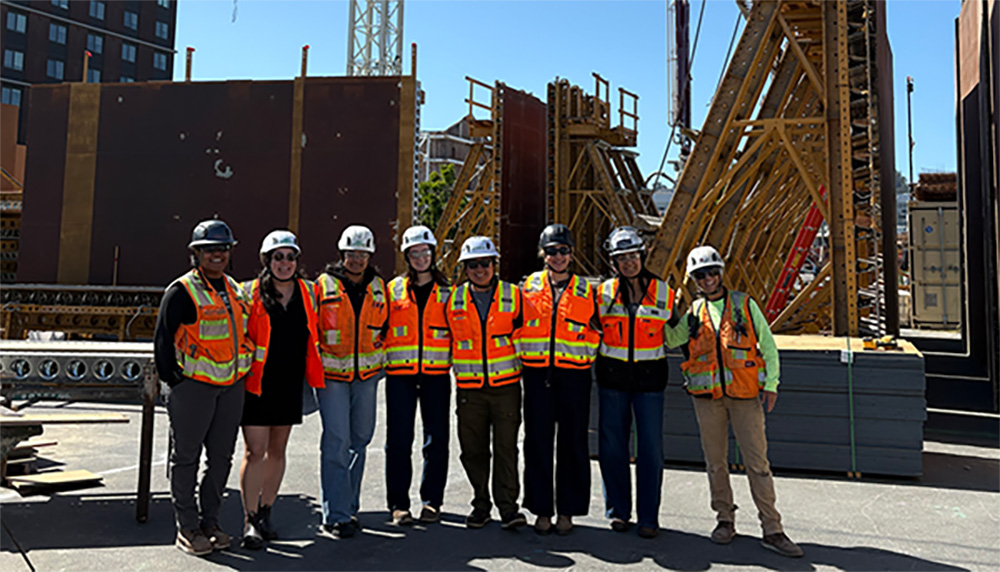
It’s a privilege she’ll never take for granted. Just three months into her time at the UCSF Life Sciences Building, she’s become part of a powerful community of women who are delivering a staggeringly complex advanced cancer center. It is a technically demanding build that will, literally, save lives. “Getting to know the women on this project—Quality Manager Melanie Walker, Sr. PE Nydia Lopez, Administrative Assistant Janelle Martin, Project Accountant Nicole Rangel, PE Allie Trevena, Project Accountant Johanna Lopez, and Carpenter Amber Sanford, to name a few—has been valuable beyond words. Sometimes we learn from one another, sometimes we support one another, and sometimes we just laugh about the absurdity of a shared experience together.
“That sense of connection is something I really appreciate. Being a female leader on this project doesn’t mean I’m there simply to set an example for other women. It means allowing their experiences and perspectives to influence the kind of leader I continue to become.”


