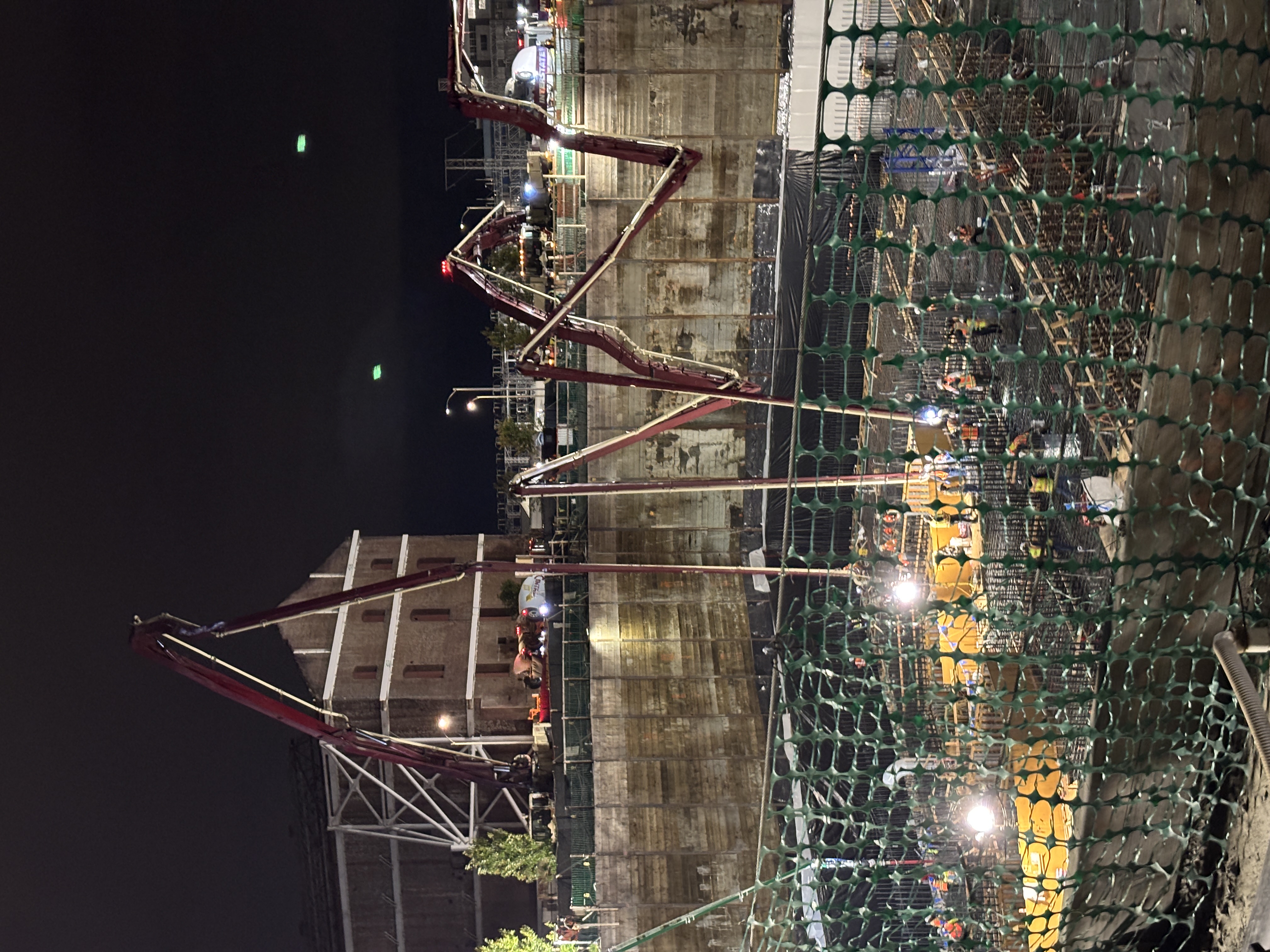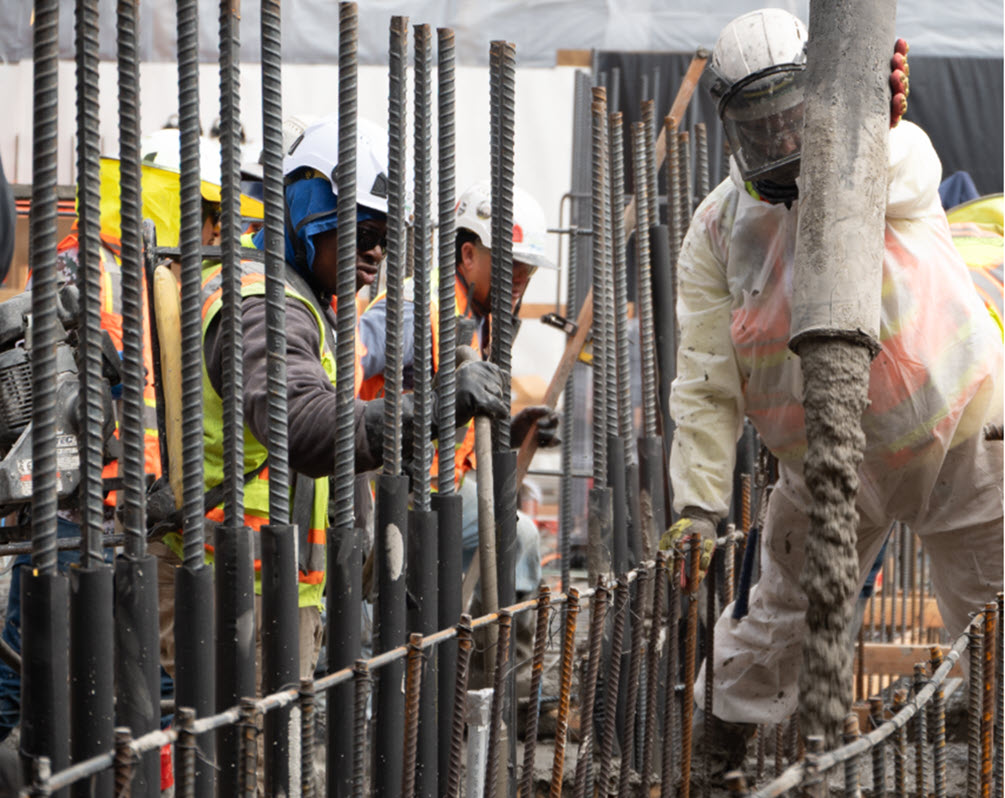
The biggest single pour Webcor Concrete Sr. VP Greg Miller remembers was about 8,000 yards. But the 5,622 cubic yards poured at the Potrero Power Station project — where construction of a UCSF Proton Therapy center is underway — added a unique layer of complexity that Greg says he'd never seen. "The shielding concrete had to meet a density higher than usual, and density testing is something that we've not encountered during my career," he says. "Having to pass a test for every single truckload of shielding concrete for density, temperature, and slump added extra pressure to the entire operation."
"It was something we’ve never done before," adds Construction Manager Joe Bell, "combining a many-thousand-yard mass concrete pour with a fifth of it being shielding wall concrete." The team had been preparing for it since August of last year.
The Shielding
The shielding wall concrete was poured around the rooms that will contain the 360-degree rotating gantries that revolve around patients during treatment. That's about 112 concrete trucks, and the temperature had to be perfect. "The temperature and density of the concrete in every single truck had to be tested before placement, which took a lot of extra special inspectors," Joe says. "I heard only three didn't pass muster. That was great."
By comparison, concrete temperature on a typical pour is tested only about every 17 trucks, and we usually don’t test for density, Greg says.
The shielding sections also required a special pump truck designed for that purpose, with flags marking the shielding zones so only that pump could operate in those two areas.
Up Against the Clock
Altogether, 562 trucks rolled through in the roughly 24 continuous hours of work that began with setup at about midnight on Saturday, June 20; the first truck arrived at about 2 a.m. That many trucks required drivers from all over the Bay Area, as well as from Napa and San Jose.
Some challenges emerged early. The first truck required a mix adjustment, and one of the pumps broke down near the start, setting the schedule back. "We didn't plan to use all five pump trucks, but we knew we were up against the clock even more than usual with concrete," says Webcor Concrete Project Manager Kenny Hua.
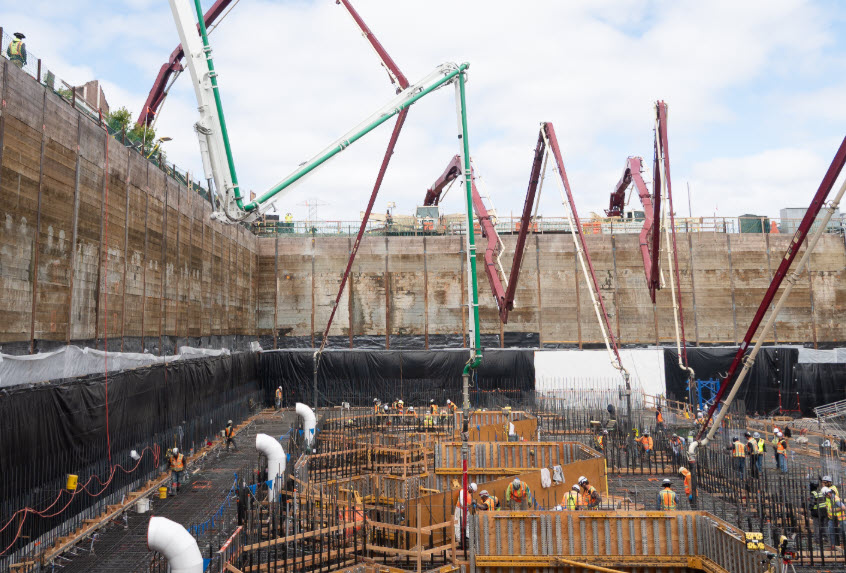
Webcor Concrete Superintendent Kelly Martz picks up the story: "We saw it going so well that we fired up the fifth pump to help us catch up on time. But when drivers have to work that many hours, DOT restrictions apply, so we worked with Central to pull drivers from all over the Bay Area, plus Napa and San Jose. We were controlled at all times, never out of control." Once behind schedule, the team pivoted to bring in a backup pump. Interstate supplied four, Webcor supplied one, and Central Concrete staggered driver shifts to make sure no one ran out of legal driving hours before the pour was finished.
Five pump trucks ultimately rimmed the edge of the excavation, more pumps working at once than most people on the project had ever seen. The site itself was crisscrossed with about 1.2 million pounds of rebar.
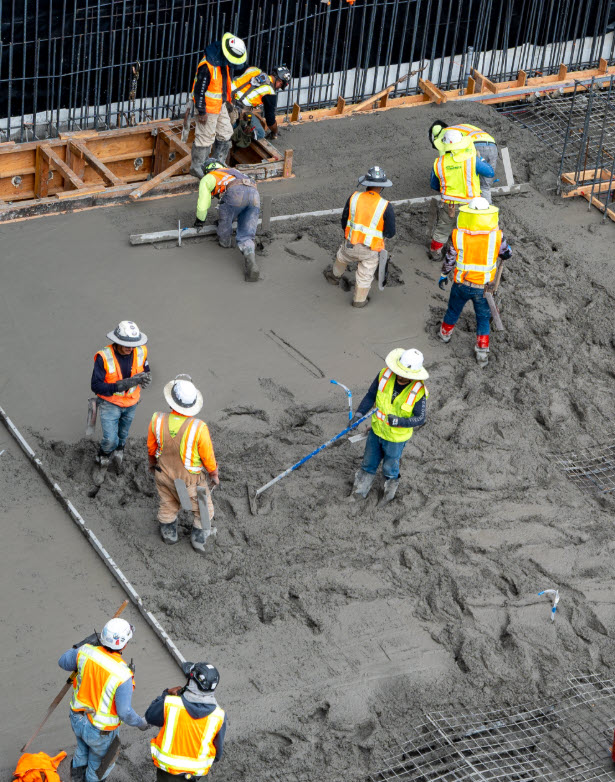
"We poured out around 11:50 pm Saturday night," Kenny says. "The finishers were here through the night, putting in a lot of hard work" to finish the top surface.
Beating the Heat, From the Inside Out
Concrete doesn't sit still once it's poured. As it cures, it generates its own heat — and in a placement this size, that heat has nowhere to go.
"Concrete naturally gains temperature — that's part of the process," Kenny says. "But because the placement was so large, the concrete in the middle gets heated not just by its own reaction, but by all the concrete around it."
A pour this big falls into the category of "mass concrete," which comes with its own rules. If the core temperature climbs above 160 degrees Fahrenheit, the concrete becomes vulnerable to internal cracking that can compromise its structural integrity. So, before the first truck ever arrived, the team built a thermal control plan, modeling how hot the placement was likely to get, then setting limits to stay ahead of the risk.
A sensor buried at the core of the deepest section tracked the temperature throughout the pour and for days afterward, climbing past 100 degrees, then 150 — eventually peaking at 152. The testing of every truck pouring shielding concrete was designed to confirm that it fell within plan before it could be placed. The heat doesn't peak right away, either; it typically builds for seven to 10 days after the pour, so the monitoring didn't end when the trucks stopped rolling.
Once the surface was finished, the crew came back to cover the concrete with insulating blankets — not to warm it, but to slow how quickly it cools. If the core stays hot while the surface cools too quickly, the temperature gap between the two — more than 35 to 50 degrees, depending on conditions — can crack the concrete from the inside out.
"It's like tucking the concrete in for the night," Kenny smiles.
The Team
The team assigned to the project was supplemented with laborers and salaried personnel from several other Webcor projects, with 45 field laborers on site and 30 supervisors, ranging from superintendents to interns. Webcor Concrete Operations Manager Adrian Meraz spent much of the pour directing the pumps himself, holding the hose, holding the vibrator, doing whatever the moment required.
"The way the operation came together was very impressive," says Webcor Sr. Project Director Bill Fish. "Webcor Concrete was crushing it and setting an example for everyone else, and our subs followed suit." Bill singles out Southland and Cupertino, which spent the preceding weekends preparing for the pour. Representatives from Fifth Space, the project developer, were also on hand.
By pushing hard on overtime and weekend work over five weeks, the team pulled the pour forward from its original schedule by nearly a week, a compression Bill credits to Webcor Concrete's planning and execution, as well as the One Webcor mentality.