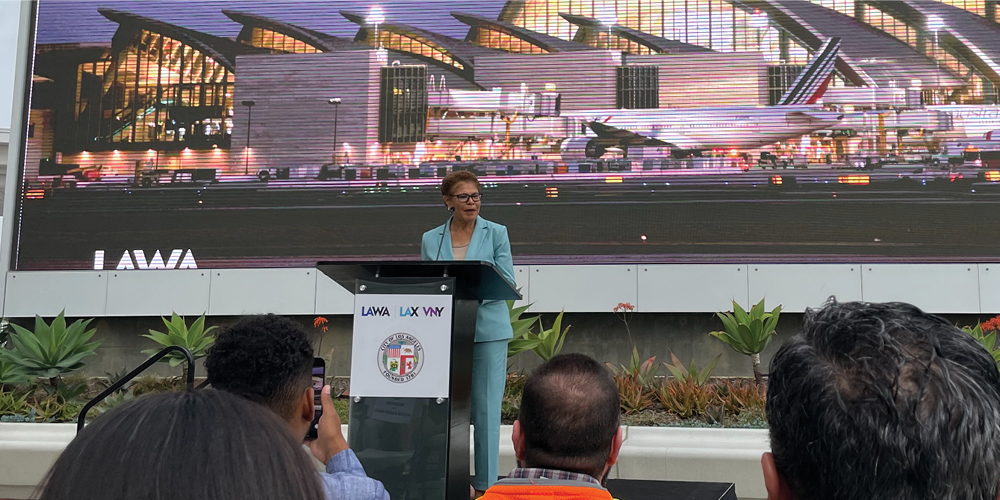
Two Webcorians were there when Los Angeles Mayor Bass held a hastily-convened press conference to praise work going on at LAX.
Two Webcor representatives -- Vice President Charles Chiparo and Project Manager April Chang-- attended a press conference hosted by Los Angeles Mayor Karen Bass to celebrate the ongoing work at LAX.
Webcor is working on a massive wayfinding project, Webcor's first at LAX. The event provided valuable networking opportunities in an intimate setting with Mayor Bass, not the first such opportunity in recent months.
"Any time we can get Webcor's name out there in small group settings with the mayor, it's helpful," Charles noted.
Mayor Bass celebrated the Multiple Award Task Order Contract (MATOC) program. This fully funded initiative prioritizes small, local, and minority-owned businesses throughout LA, including some of Webcor's trade partners from Hollywood Park Retail and COSM. The MATOC covers a pool of design-build projects across the LAX campus. It accommodates a variety of facility upgrades. Taken together, the MATOC projects represent approximately $5 billion in construction value.
Webcor has been prequalified for the MATOC and is responding to select Requests for Proposals (RFPs) issued by the airport under the MATOC.
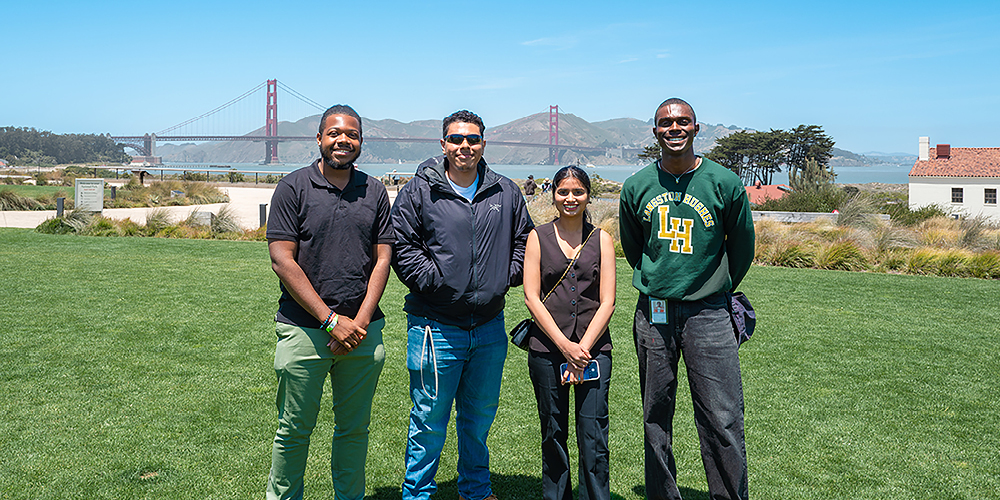
Nearly 60 project engineer (PE) interns and ACE Mentor externs joined this year’s Intern Welcome Event and ERG (employee resource group) Rush for a rare chance to meet their fellow interns/externs across all projects/departments.
It was also a great opportunity to introduce themselves to the many Webcor engineers, superintendents, managers, directors, and executives who showed up to support and connect with the next generation of Webcorians.
“We have limited time with the interns each summer, so it’s imperative that we take advantage of our opportunities to demonstrate our values and culture,” says Project Manager David Friend. “In LA, we had a great turnout from the interns, ACE externs, and their managers, which was very appreciated. The high turnout from local leaders and ERGs was the cherry on top.”
This year, the intern and ERG teams combined the Intern Welcome Event and ERG Rush into a single event to maximize 1) ERG Rush attendance and 2) interns’ time with the ERG/s they chose to join. Both teams decided this approach would be more effective than hosting ERG Rush in August after work hours, as they’d done in past years.
Their efforts paid off—nearly all interns/externs joined this year’s event and listened closely to ERG leaders’ presentations during the Rush portion.
“Learning about Webcor’s ERGs and the type of support they offer employees of different identities and backgrounds was my biggest takeaway,” says Ava Grochowski, a civil engineering major at UC Berkeley who’s interning at Santa Clara Valley Medical Center (SCVMC) Behavioral Health Services Center (BHSC) this summer. “I felt like the ERGs created a safe sense of community, which I appreciate.”
This year’s NorCal event was held at Tunnel Tops Park in San Francisco’s scenic Presidio neighborhood. Interns/externs on Bay Area projects and the Reno ConRAC project gathered for an afternoon of lawn games, pizza/drinks, relaxed conversation, and connection.
“I loved the ice-breaker games we played for Webcor-branded items,” Ava says. “I won a Webcor mug, which made me very happy. But beyond that, the games made it easier to socialize afterward. It was a great way to become familiar with people’s faces.”
In downtown Los Angeles, intern managers hosted the SoCal event at LA Live’s Lucky Strike bowling alley. Several ERG leaders, including CFO/CAO/Sr. EVP Matt Reece, traveled from NorCal to meet our SoCal-based interns and introduce them to each group.
As The Collective’s executive sponsor, Matt kicked off the presentations with an overview of the ERG and emphasis on the significance of our overall ERG program.
“As someone who identifies with one of the ERGs, I thought they sounded like a great resource,” says Jordan El Azzam, a computer science major at UC Irvine who’s interning at UCI Mesa Court Housing Expansion. “It’s comforting to know there’s support available to employees if needed.”

Last month, 21 project engineers (PEs) and senior project engineers traded their ThinkPads for tool bags and monitors for PPE in preparation for a week of building at New Engineers Will Build (NEWB).
For nearly a decade, NEWB has completely redefined PEs’ and Sr. PEs’ idea of a hard day’s work by pulling them far from the comforts of the office and throwing them into the grind of the field.
The five-day crash course in all things Webcor Craft includes daily lessons and demonstrations with our concrete, drywall, and carpentry experts; insightful lunchtime discussions with Webcor executives; and team collaboration like they’ve never experienced before.
Each year, NEWBs are expected to build their assigned structure/s with their teammates by the end-of-week deadline. The field exposure is priceless—and humbling. Aside from instilling a level of appreciation for craft professionals that can only be understood through firsthand experience, NEWB gives participants a chance to see how their work (and mistakes) in the office influences what plays out in the field.
“It’s a very eye-opening experience,” says Project Engineer Yessica Mares Barriga, who went through NEWB this year. “As PEs, it’s difficult for us to understand just how much work goes into building something. It’s a great chance to actually be ‘bags-on’ and work outside instead of behind a screen writing RFIs and submitting submittals.”
This year’s NEWB leaders were Parker Jones and Jordan Davis, two SPEs who completed the program last summer at UCSF Health Helen Diller Hospital’s prefabrication yard.
The prefab yard setting left little opportunity for permanent in-place work—something Jordan and Parker were determined to incorporate in this year’s program. Fortunately, this year's location offered plenty of flexibility for NEWB’s leaders and mentors to plan activities that would immerse participants in hands-on building while leaving behind something beneficial for the project:
Monday: Layout, Formwork, & Concrete Pad Pours with Curbs
Tuesday: Layout & Framing
Wednesday: Drywall
Thursday: Doors, Frames, Hardware, & Curb Chipping
Friday: Picnic Tables
There’s no doubt that the mornings were about working hard, typically starting with a team huddle at 6 a.m. before transitioning to the day’s workload. But the evenings were about playing hard.
As any NEWB graduate will tell you, you don’t just end the week with hands-on field exposure, a heightened appreciation for craft professionals, and a new perspective on the impact of your work in the office; you also leave with friendships. Few experiences bond Webcor PEs and Sr. PEs quite like the universal exhaustion, confusion, frustration, and massive learning curve inherent in NEWB.
“Jordan, the NEWB mentors, and I all felt that the relationships we built during our NEWB weeks were the most meaningful takeaway,” Parker says. “With that in mind, we made sure this year’s program balanced challenging, rewarding work with space for after-work activities so NEWBs could spend time together outside of work.” “Jordan and I hope the NEWBs walked away with a greater appreciation for the craft and skill behind trade work, as well as real connections with their PE class. Most importantly, we hope they had fun.”


