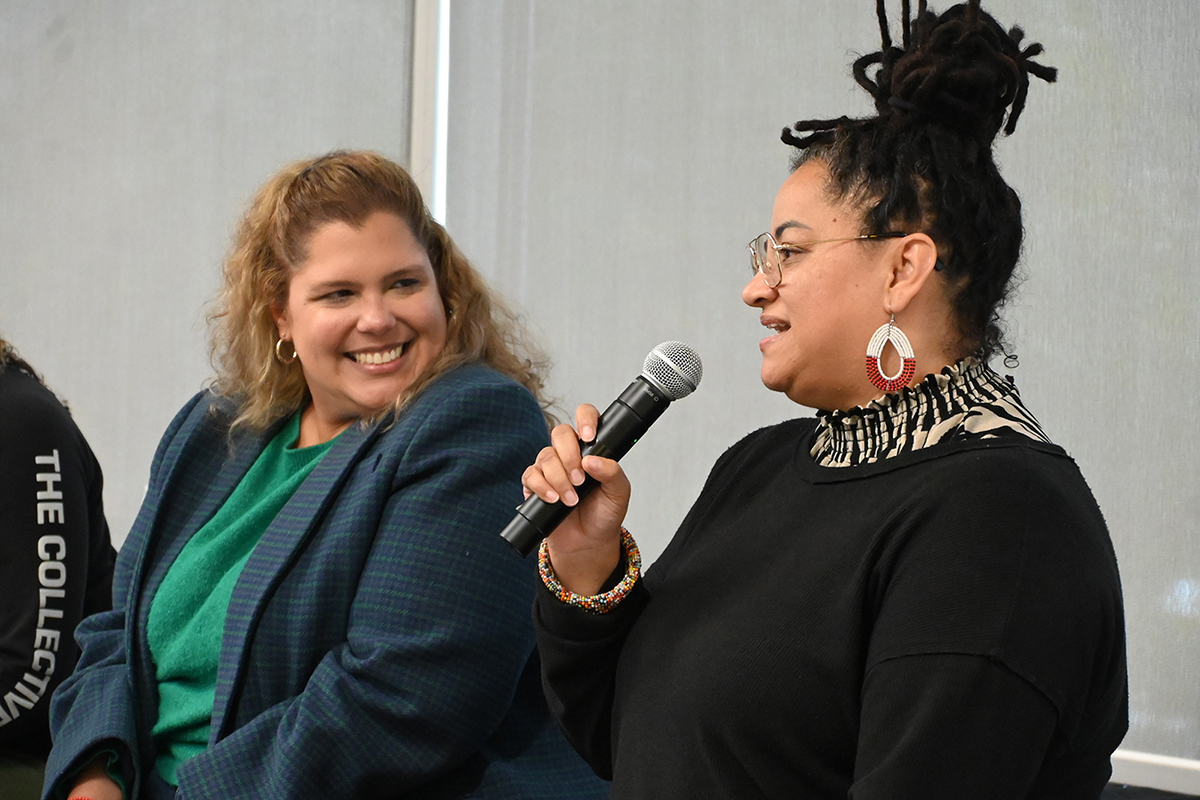
After being treated like an outsider for nearly 20 years, Sandra’s first year at Webcor has felt like a breath of fresh air.
Executive Assistant Sandra Blanco has lost count of the times people have brought up her hair.
Over the last two decades, she’s heard it all: “How do you wash it?” “How long did it take to get done?” “Is it fake?” “It looked better when it was curly.”
“Sometimes, people would just start touching my hair,” she recalls. “One person told me that my hairstyle reminded them of a basketball player who also had locs. I knew who they were talking about—his hair looked nothing like mine.”
The people who most often made such brazen comments? Her colleagues at her last company.
“Most of the comments and questions came from coworkers I’d never seen or met before, as there were thousands of us in a single location,” she says. “One time, I was chatting with three women from my team—all of whom were white—when one of them, who lived in Walnut Creek, said she was upset that her kids were making friends with children who lived in Pittsburg, which has a large Latino and Black population. She even said she told her kids to ask other students what city they were from before becoming friends with them because she didn’t want them associating with kids from Pittsburg. At the time, that’s where I lived. Even now, it hurts to think about that conversation.
“I think it really said a lot about that company’s culture. It would have been amazing to have an ally back then—someone to advocate for me, especially when I wasn’t in the room.”
In late 2024, Sandra’s company informed her they’d be relocating her to Houston, TX. It felt like the perfect time to explore other options—she was tired of her coworkers’ microaggressions, and she had no interest in leaving the Bay Area.
After telling her longtime friend, Prequalification Analyst Chanelle Jones, about her situation, Chanelle encouraged her to apply for the executive assistant position at Webcor’s Alameda office. If the opportunity worked out, Chanelle assured her, she’d be spending her days in a healthy work environment with respectful, empathetic colleagues.
She received Webcor’s offer letter a few days later. After 18 years, she decided it was time to take the leap and leave her former company.
Settling into the Alameda office felt effortless—like a wave of relief washing over her. Throughout her first week, she was warmly welcomed by her Alameda teammates and executives: EVP/Chief People Officer Mei Lin Wolff and CFO/CAO/Sr. EVP Matt Reece. For the first time, she felt genuinely accepted—even embraced—by her colleagues.
Her first few weeks flew by as she continued learning about Webcor and befriending more coworkers. Little did she know, she’d soon find a whole new level of community in Webcor’s Black employee resource group (ERG)—The Collective.
Finding Trust & Community in The Collective
When Sandra joined her first Collective call, she was immediately struck by the frankness and openness of the members’ conversations. No topic appeared to be off-limits.
“As I sat there and listened, something in me immediately settled,” she recalls. “I loved the unique blend of personalities and the progressive, forward-thinking mindset everyone brought to the discussion.”
Since that first meeting, her fellow Collective members have become much more than coworkers. They’ve supported her through difficult times, celebrated with her during joyful ones, offered thoughtful professional advice and guidance, and reminded her she always has a safe space with them.
When The Collective’s leaders (HR Specialist Dante Robinson, Outreach and Partnerships Manager Sharla Sullivan, and Assistant Quality Manager Melanie Walker) nominated Sandra to represent them at Webcor’s ERG-led Construction Inclusion Week (CIW) panel last October, she didn’t hesitate. The opportunity to represent the group that had given her so much was an honor she couldn’t pass up.
On Oct. 14, she joined representatives from Webcor APAC (Asian-American/Pacific Islander ERG), Webcor Q&A (LGBTQ+ ERG), Fuerza (Latinx ERG), and Women of Webcor for a candid discussion led by Sr. Director, Insurance & Risk Management Andy Stoelting. As she nervously awaited her turn to speak, she realized her anxiety was far outweighed by her determination to educate attendees—on the significance of ERGs like The Collective, on the ways Black people’s reality differs from others’, and on the simple fact that people from various cultures and backgrounds exist at Webcor and deserve to be respected.
As Sandra voiced her thoughts to Andy’s questions on cultural identity and The Collective’s indelible impact on her employee experience, she locked eyes with Matt Reece and Mei Lin. Both executives had shown up to not only support Sandra in person but learn from her (and her fellow panelists’) perspectives and experiences.
“Seeing Matt and Mei Lin in the audience felt incredible,” Sandra says. “Their support truly meant everything to me.”
As she rounds out her first year at Webcor, Sandra looks forward to exploring new ways to “bridge and deepen the connection” between Webcor’s Latino and Black communities and recruit/retain more Black employees—a Collective goal particularly close to her heart.
Webcor: The Perfect Culture Fit
After being treated like an outsider for nearly 20 years, Sandra’s first year at Webcor has felt like a breath of fresh air. Everyone from her fellow executive assistants (EAs) to her colleagues at the Alameda office have welcomed her with open arms and offered their support—without a single ignorant comment.
As Webcor’s newest EA, Sandra credits the entire EA team for going above and beyond to set her up for success and ensure she feels confident in her new role. “Sr. Executive Assistant Tanja Huni has helped me tremendously in learning how to get things done properly here!” Sandra says.
However, no one has shown up for Sandra quite like Dante, who’s had her back since day one. That day, shortly after signing into Workday to complete her new hire trainings, she was faced with several technical issues that went over her head.
“Dante stepped in with patience, kindness, and a genuine willingness to help,” Sandra recalls. “Since then, he’s supported me in more ways than he probably realizes. Dante, I hope you’re reading this!
“Dante’s inclusive leadership during The Collective meetings is the reason I attend every single one. He shows no bias, welcomes different perspectives, and creates a space where everyone feels valued. He’s been there during difficult moments in the office by simply listening, offering support, and helping me navigate challenges.
“In December, he guided me through the process of taking a two-week medical leave, showing the same positivity and professionalism he brings to everything he does. His attitude is consistently uplifting. Truly, he’s a superstar. Webcor is incredibly fortunate to have him, and I look forward to seeing where his career grows from here.
“I’m so thankful to be here at Webcor and to have found such a special community in The Collective. Every member is insightful, intelligent, and excited to contribute something valuable. I can’t wait to see what the future holds!”
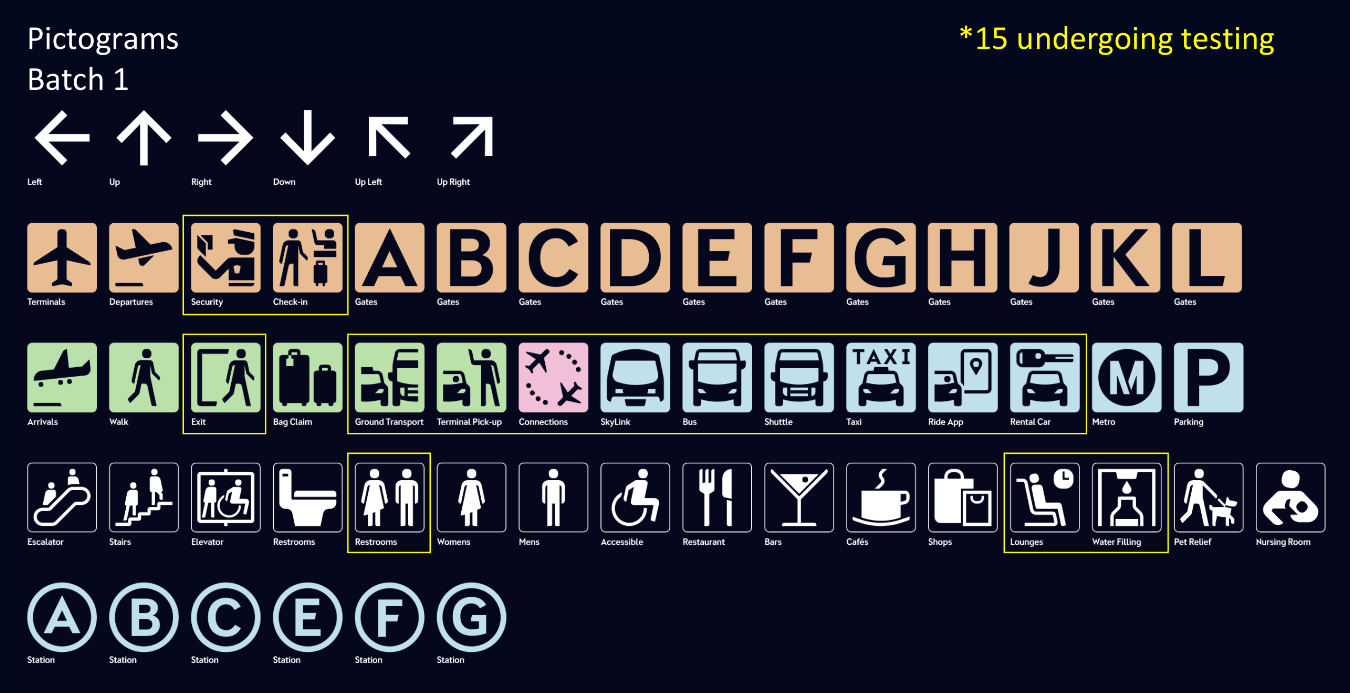
When we signed on for the wayfinding project at LAX, designers found themselves staring down a new challenge: building a font from scratch.
LAWA has engaged Webcor–Gensler to deliver design-build wayfinding upgrades across LAX’s 3.8-million-square-foot campus in preparation for the 2028 Olympics. The scope includes enhancements to both static and digital signage, implemented in phases across all terminals, parking garages, APM stations, and the airfield. The Wayfinding Enhancement Program also encompasses a comprehensive update to LAWA’s Wayfinding Standards, aligned with a full terminal and gate renumbering initiative to establish consistent, airport-wide naming and numbering in support of a world-class passenger experience.
According to Webcor Sr. Design Manager Aileen Santos-Redman, the signage at LAX has relied on a hodgepodge collection of Helvetica – including some "fake" versions that have crept into the system over the years – for decades. While Helvetica is a workhorse of the design world, it lacks a certain soul. As part of a broader effort to bring "LA" back into LAX, the project team realized that a world-class gateway deserves its own distinct voice.
It’s easy to think a font is just a decorative choice. In a high-stress environment like an international airport, wayfinding is a critical utility. The fact is, the old signage wasn't cutting it.
“The goal was to create something that felt authentically Los Angeles while solving some major legibility issues,” says April Chang, project manager who was on the team when the initiative first took flight.
The team partnered with Dalton Maag, a renowned typeface design studio in London, to develop a unique LAX wayfinding font.
How do you distill the essence of Los Angeles into a set of characters? You look at history. The designers drew inspiration from iconic local landmarks, including the Beverly Hills Hotel's typography.
The font design has been more than just a design exercise; it's a call for better functional aesthetics in our public infrastructure.
The fonts will also apply to maps, which will be tested for the effectiveness of elements such as “You are here,” doors and gates, route lines, and more.
“The whole experience has been enlightening,” Aileen says. “As a traveler, I know signage is something I count on, and I have been critical of wayfinding systems that don’t work well. But getting involved with this was eye-opening in terms of the many elements of font design that I’ve never even thought of.” That includes the colors – which have to work well with the font in both light and dark modes – and associated pictograms (those symbols you see that designate restrooms, taxi stands, bars, and other amenities). Colors must also work well for passengers and employees with color vision impairments.
Aileen is now focused on the practical application of this new tool. While the official name of the font remains under wraps, it is a specialized derivative of the benchmark Interface font, designed for the unique distances and lighting requirements of an airport terminal.
The rollout is a massive undertaking. “We are not just talking about a few signs,” Aileen says. “We’re talking about a systemic update to maps, digital displays, terminal and gate signage, and other physical wayfinding across the entire LAX campus.” This requires ongoing dialogue between builders and design teams to ensure the physical structures accommodate the new visual language.
For example, comprehension studies were conducted among LAX travelers and employees to assess the effectiveness of the proposed pictograms.
The wayfinding project reminds us that every detail matters in the employee and traveler experience. Webcor is helping to build more than just walls and gates; we are building the first impression millions of people have when they land in California.
The move from "off-the-shelf" Helvetica to a bespoke LAX font is a significant shift in how the airport communicates with its passengers and staff. It turns a functional necessity into a branded experience that tells people exactly where they are—Los Angeles—while also tying the LAX campus together as a whole.
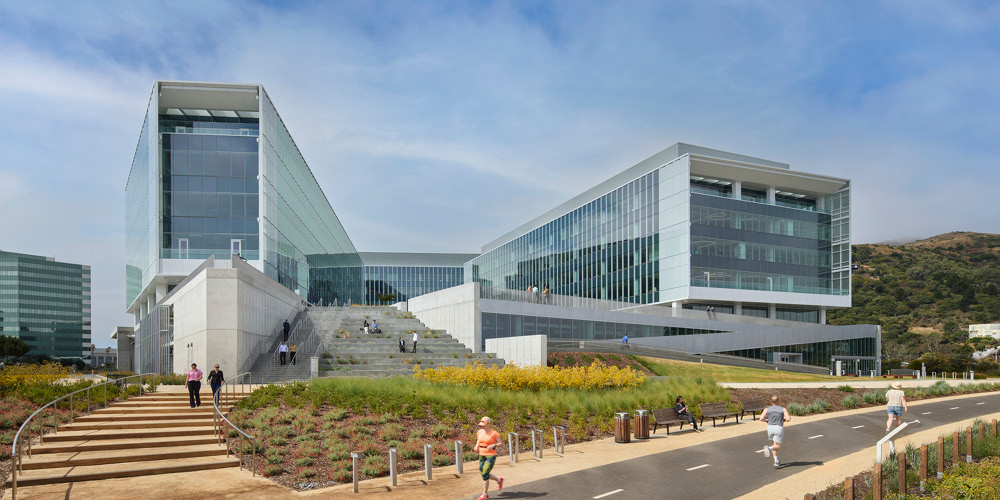
Webcor's Sustainability department embeds sustainable practices into daily workflows, from pursuit and preconstruction through project closeout.
by Ava Brasch, Marketing Coordinator
When it comes to sustainability at Webcor, the work goes well beyond recycling bins and green walls. Led by Sr. Sustainability Director Sarah Rege and Sustainability Manager Kavita Karmarkar, the Sustainability department embeds sustainable practices into daily workflows, from pursuit and preconstruction through project closeout.
But what does this look like at the project level? Behind the acronyms and rating systems, the Sustainability group helps project teams evaluate materials, track and reduce carbon emissions, and find new ways to eliminate waste.
"Almost every job we touch has a different sustainability scope," Kavita explains. "Our job is to meet teams where they are and help them move forward."
Setting the Foundation Early
Project teams often first engage with Sustainability during pursuit and preconstruction:
Pursuits
Preconstruction
They also introduce conversations about embodied carbon, lifecycle costs, carbon emissions during construction and California's evolving building codes early, so owners can make informed decisions. This proactive support helps clients see sustainability as an opportunity, not just an added cost.
Handoff, Kickoff, and Construction
Once a project is awarded, the team establishes frameworks for success through sustainability kickoff meetings, designated sustainability champions (often project engineers (PE) or senior (SPE), and Green Team initiatives. Webcor provides funding to support on-site sustainability initiatives like plant walls, reusable bottle drives, composting, and TerraCycle programs.
Kavita works with project teams throughout construction, offering biweekly or monthly check-ins with customized tracking spreadsheets and ready-made templates. "One thing at a time," Kavita says. "That's how we keep teams from feeling overwhelmed."
Those touchpoints cover everything from waste hauling contracts to material submittals (e.g. ensuring they include environmental product declarations and recycled content data)—avoiding the last-minute scramble that could occur at closeout.
Concrete, Carbon, and Innovation
One of the team's most important focus areas is embodied carbon—the emissions associated with building materials.
In new construction, primary structure is the largest contributor with concrete most often the major contributor. With this in mind, concrete is a major target for reductions. The Webcor Concrete Group is deeply experienced in lowering embodied carbon in concrete. They experiment with low-carbon mixes and pilot new technologies with the potential to replace traditional cement in concrete mix design. Sustainability works with the concrete team to integrate these efforts into each projects holistic sustainability goals. The sustainability team translates to clients and design teams how the focus on concrete can be a needle-mover in embodied carbon reductions.
Using tools like EC3 (Embodied Carbon in Construction Calculator, which Webcor had a hand in developing), they analyze options and guide smarter choices, positioning us as a leader in greener construction practices.
Delivering Results
As projects near completion, Kavita and Sarah finalize all documentation for certification submission, ensuring teams don't miss critical steps. The team's support is reflected in the results:
"Projects like these show what's possible when sustainability isn't just a checklist," Kavita shared. “Sustainability becomes part of the project’s identity.”
Looking Ahead
Sustainability at Webcor continues to evolve. Last year, we earned a Bronze rating from EcoVadis, and we published our inaugural Sustainability Report in September.
Their biggest goal remains clear: ensuring every Webcor team understands how, when, and why to involve Sustainability early.
"The sooner we're looped in, the more value we can bring,” Sarah says.


