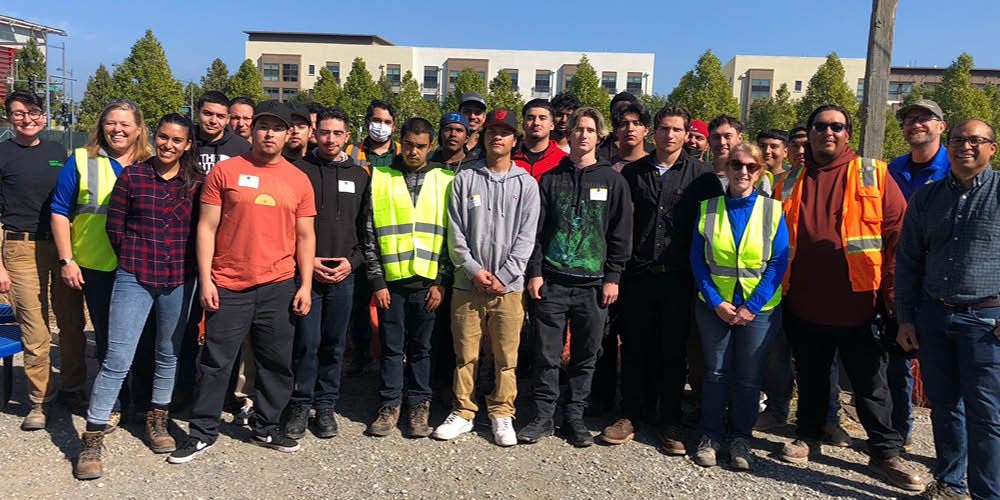
For decades, Safety Manager Larry Spencer has encouraged high school graduates who can’t fathom another four years sitting at a classroom desk to consider workforce development programs and apprenticeships.
Contrary to what most students are told, college isn’t for everyone—and that’s OK.
As an industry veteran and former high school football coach, Safety Manager Larry Spencer understands that better than anyone. For decades, he’s encouraged high school graduates who can’t fathom another four years sitting at a classroom desk—and after that, many more sitting at an office desk—to consider workforce development programs and apprenticeships.
“You finish the program without any student debt and often get paid to learn your craft,” he says. “It’s a great option to pursue instead of college.”
In late 2020, Project Director Ted Williams connected with Fortitude Careers, a Peninsula-based nonprofit just getting off the ground. Designed to introduce young adults from underserved communities to the construction trades, Fortitude equips their students with the basic certifications and skills (both technical and soft) needed to get started in construction.
The entire program is free of charge to participants.
About 72 percent of Fortitude graduates have landed industry jobs after completing their eight-week Summer Build program.
After speaking with Fortitude’s founder, Nicole Davis, about how Webcor could support, Ted decided to reach out to Larry about possibly leading Fortitude’s safety certification trainings. At the time, Larry and Ted were working together at Bay Meadows Stations 1 & 5 in San Mateo, just a few minutes from the San Mateo Event Center where Fortitude’s classroom sessions were held.
“Not everyone can coach high school football,” Ted says. “Motivating and training young adults require a certain skillset. The same goes for leading trainings as a safety manager—it requires the ability to connect with people and deliver messages that resonate.”
Without hesitation, Larry agreed to step in and support as a mentor and safety trainer. Over the last five years, he’s helped Fortitude students earn certifications in OSHA 10, flagger training, and the operation of essential construction equipment like forklifts, scissor lifts, and boom lifts. At Bay Meadows, he led the safety portion of Fortitude’s ECC workshop, a Fortitude initiative in which students tour an active project site and meet construction team members.
“Just because you have the technical skills doesn’t mean you can teach it, and just because you can teach it doesn’t mean you can inspire people to listen,” Ted says. “Larry’s a naturally inspiring teacher and mentor. The way he approaches the subject matter motivates students to pay attention, learn, and emulate his professionalism and dedication.”
Since Fortitude’s ECC at Bay Meadows, Fortitude has organized 13 ECCs at various active projects, including Isle House and the Biosolids Digester Facilities Project (BDFP). To date, Fortitude’s ECCs have served about 225 students interested in construction careers.
Today, Larry’s commitment to Fortitude’s students remains stronger than ever. Last month, he returned to Fortitude’s Summer Build Program to help their latest cohort get certified in the usual construction equipment essentials.
The severity of our industry’s labor shortage cannot be understated. As more construction professionals retire from the workforce, it’s increasingly vital that we come up with creative, effective strategies to recruit the next generation of builders—strategies like our Fortitude partnership.
“From an inclusion standpoint, we believe that’s important,” Ted says. “Fortitude offers students that crucial access to training and industry education. We need to continue finding and engaging with diverse recruitment avenues like Fortitude to find qualified construction talent.”
Our partnership is mutually beneficial. The more GCs and industry professionals get involved, the more others will be inspired to follow suit and invest their time/resources in workforce development programs like Fortitude—time/resources that are essential to their continued growth.
“Larry’s support directly benefits ‘opportunity youth’ by helping them build long-term careers in construction,” Nicole says. “He’s played a crucial role in sustaining Fortitude’s program and strengthening our partnership with Webcor. Thank you, Larry, for being a cornerstone of our mission, sustaining force in our program, and catalyst for industry partnerships that uplift opportunity youth and strengthen the construction workforce!”
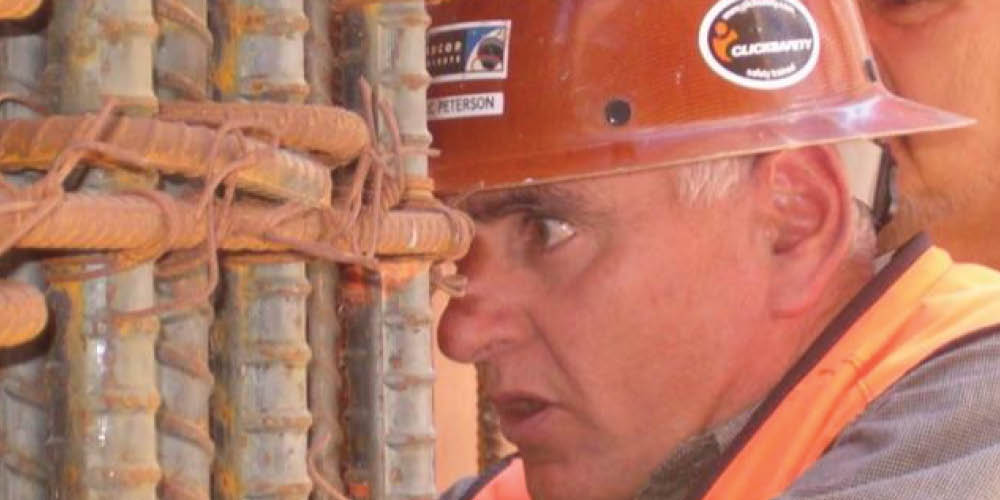
Living on an Arizona ranch at the age of 16, Eric Peterson had his first experience with concrete.
"We made our own formwork, acquired the materials – sand from the washes, rock from an abandoned railroad right-of-way, and cement (at $1.00/100 lb. sack) -- mixed it on-site, poured the walls, baffles, and precast lids for a 2,000-gallon septic tank," Eric remembers. Everything was done by hand, pick, shovels, and mixed with a one-sack mixer, loaded by hand. We also built a concrete house using the same methods and labor (mostly me 😊).”
While the Webcor Concrete director built a diverse resume in construction after that, including carpentry and welding while working in the field, he continued to gravitate toward concrete.
“I liked working on structures. I started pursuing concrete projects instead of wood frames because I liked concrete as a material. The projects were more interesting and lasted longer.”
That affinity for concrete, and everything he has learned about it since, has culminated in the American Concrete Institute (ACI) awarding Eric the Roger H. Corbetta Concrete Constructor Award.
The ACI bestowed the honor on Eric "for his invaluable knowledge, dedication, and leadership in the development of ACI standards to improve concrete constructability by providing guidance on construction specifications, formwork design, construction tolerances, and sustainable concrete construction practices."
The award will be presented at the ACI Fall 2025 Concrete Convention's Excellence in Concrete Construction Awards and Gala in Baltimore on Monday, October 27."
The American Concrete Institute is a U.S. authority on concrete design, construction, and materials," says Webcor Craft EVP Chris Plue. "This code-writing body is comprised of engineers, academia, and contractors and is charged with ‘always advancing’ the concrete industry."
Along with codes developed by similar institutes worldwide, the ACI's codes are frequently adopted by code institutions, such as the International Code Council (ICC).
"The most well-known code is ACI 318," Eric says, "Building Code Requirements for Structural Concrete and Commentary. This is a widely used code in the U.S. and in other countries."
"Having Eric recognized with this award is a testament to his service and dedication on behalf of contractors everywhere," Chris says. "Over the last decade, he has spent countless hours working to improve the code through collaboration with other industry professionals. Eric is a true expert in the material science of concrete."
The award was established in 1972 to honor Roger H. Corbetta, a past president of ACI, in recognition of his creative leadership and contributions to the use of concrete in construction. Recipients are either individuals or firms who have introduced innovative methods, technologies, or solutions in concrete construction.
Eric had been a longtime ACI member when he transitioned into supervision and found himself needing to acquire more in-depth technical knowledge. At about 50 years old, he decided to get involved with ACI committees "to give something back, to help contribute to the industry based on industry experience." Since 2007, Eric has served on ACI committees, contributing to the development of standards and codes.
Eric remains active, serving on five ACI technical committees; he also serves on the Concrete Innovation Council and the Strategic Innovation and Research Committee of the American Concrete Institute Foundation.
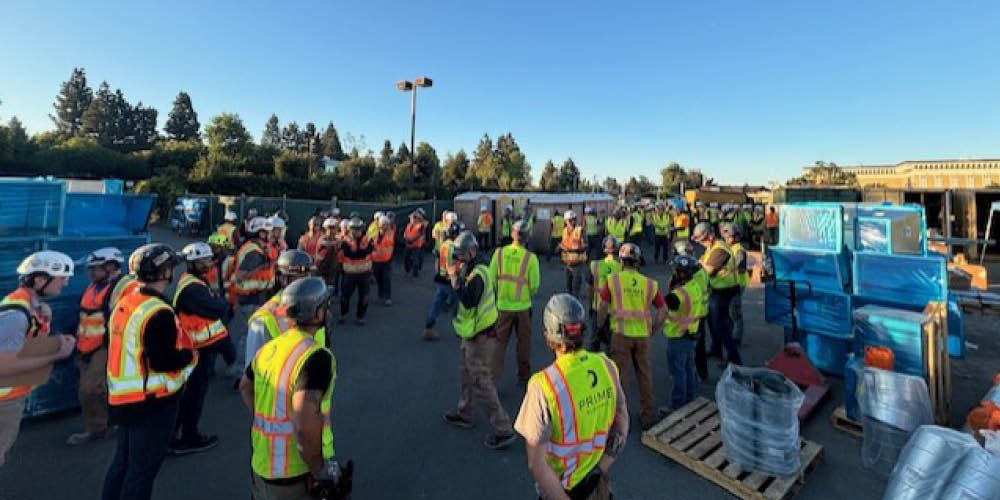
The Washington Hospital project has established an exceptional safety culture that goes far beyond typical construction site protocols.
The Washington Hospital project has established an exceptional safety culture that goes far beyond typical construction site protocols. Working within an active healthcare facility while maintaining full hospital operations requires extraordinary measures to protect both patients and workers.
The project team has implemented comprehensive safety practices that have not only ensured zero incidents but have also built remarkable trust with Washington Hospital Health System (WHHS) staff.
Hospital construction presents unique challenges that standard construction sites never face, says Project Manager Saurabh Bisen. “The team must maintain hospital function while simultaneously demolishing and rebuilding critical infrastructure. This requires strategic coordination with scheduled shutdowns performed during late-night hours, extensive scheduling oversight, and daily coordination with hospital staff and security to ensure both efficiency and safety.”
Washington Hospital’s staff welcomed Webcor’s crew with open arms after witnessing their safety-conscious approach and commitment to maintaining the highest standards, says Saurabh, who credits Safety Manager Phil Nunez and Sr. Superintendents Karl Jeppesen and Maria Damas with coordination of the complex safety program. This mutual trust has become a cornerstone of the project's success.
Process ICRA protocols are essential for maintaining sterile environments within active healthcare facilities. The team maintains visible ICRA postings throughout the hospital in coordination with the hospital safety team as new workspaces are created and demolition areas are completed. Daily maintenance and monitoring of tack mats and negative air machines ensure adequate dust containment and air quality throughout each shift.
Interim Life Safety Measures ensure that fire safety and emergency protocols remain intact during construction activities. These measures require careful coordination with hospital systems and staff to maintain safety standards while construction activities are ongoing.
The team conducted innovative mock evacuation drills to test emergency response effectiveness. Since WHHS does not allow radio use inside the active hospital, the construction team developed a unique whistle system to alert craft teams during emergencies. The evacuation drill achieved remarkable results: complete evacuation and headcount of all subcontractors in just 7 minutes from start to finish.
Maintaining a dust-free environment is critical in healthcare settings. The team implemented baseline sound and air quality sampling to measure conditions and implement necessary controls. This comprehensive approach includes negative air machines, tack mats, and scheduled off-hours work to minimize impact on hospital staff while creating the safest possible environment for both patients and construction workers.
The primary challenge was maintaining full hospital functionality while performing demolition and reconstruction work. The team addressed this through strategic planning, including:
The safety-conscious approach has significantly impacted the overall team culture, fostering increased collaboration and trust between construction crews and hospital staff. The Washington Hospital team's confidence in the construction crew's safety practices has created an environment of mutual respect and cooperation.
A particularly proud moment occurred when the executive team happened to be on-site during the evacuation drill. “The positive feedback received that day reinforced the impact that prioritizing safety has had on the entire project,” Phil recalls.
Phil shared Special recognition of key team members who made this safety culture possible:
The team's commitment to safety culture extends to recognizing and celebrating the workers who make it possible. The upcoming Webcor BBQ Field Appreciation Day demonstrates the project's commitment to acknowledging the hard work and dedication of all team members who contribute to this exceptional safety record.


