The construction industry has a long memory, and those who have spent decades on a jobsite know that the most valuable education happens when a project engineer is staring down a major time crunch, a trade model that doesn't match the as-built, and a superintendent who needs an inspection report by morning. For the last several years, the Associated Schools of Construction (ASC) Regions 6 & 7 Competition in Reno has served as the ultimate pressure cooker for engineering students to experience these exact scenarios.
While many companies view university recruitment as a passive exercise – a booth, some brochures, and a generic pitch – Webcor treats Reno as a strategic necessity. With the talent war won in the trenches, providing students with a direct, hands-on experience of our culture and technical rigor is a compelling way to ensure the next generation is ready for the field.
The Anatomy of a Problem: Washington Hospital
Every year, Webcor’s VDC (Virtual Design and Construction) team selects a case study based on an experience on an actual project to serve as the problem for student teams to solve. This year, the focus was on the Washington Hospital Tenant Improvement (TI) project. It was a departure from previous years, introducing the added complexity of a healthcare environment. Students weren't just coordinating drywall; they were navigating the nuances of an operating hospital and the logistics of installing a heavy MRI magnet.
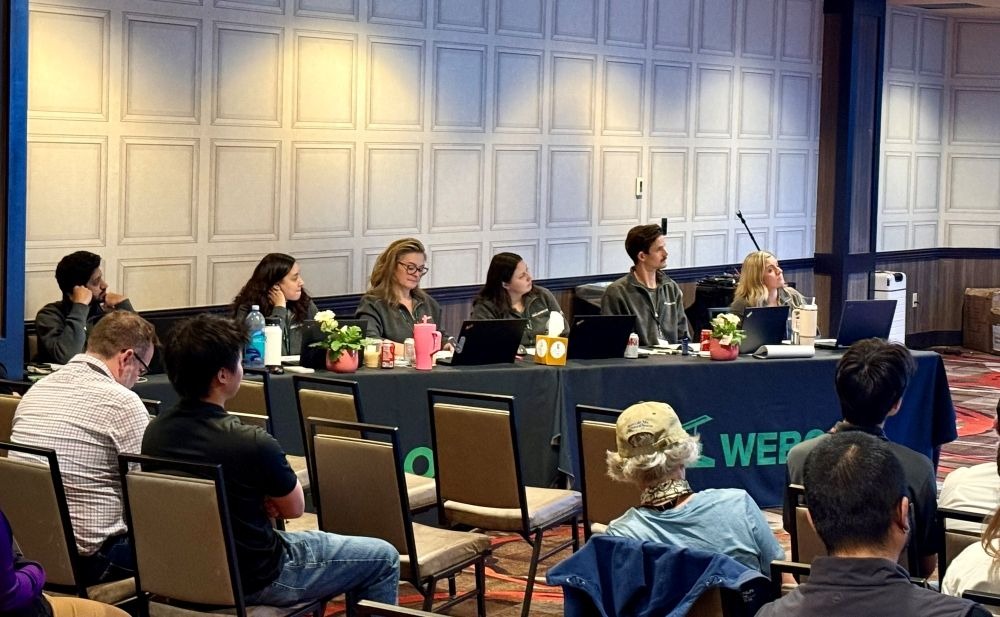
The problem statement comprised seven distinct challenges across three core specialties: estimating, logistics, and scheduling. Teams had to divide resources and "think about it in advance," as judge Annie Eismeier, VDC manager based in Los Angeles, noted. "At the start of each session, they had to assess the problems and how best to allocate resources. They had to divide and conquer."
The estimating portion was particularly grueling. "It was a hard-bid project," explained judge Rachel Johnson, a San Francisco-based preconstruction project manager. “We put that into the problem. They had to deliver a hard-bid proposal in the afternoon, similar to what a real hard bid would be like."
Moving Beyond the Digital Model
A recurring theme at Reno is the transition from "bits" to "atoms". The VDC problem team ensured the digital models had physical consequences. Webcor’s judges built a replica of the MRI room in the competition room, and students had to perform a laser scan of the mockup to find discrepancies. "The task was: the superintendent has an inspection tomorrow," Rachel says. "Go do a laser scan to make sure it's all correct. You need to give a report to the superintendent about what's been installed incorrectly and provide any recommendations."
After taking turns with the laser scanner, the students had only a few hours remaining to review the point cloud data versus the coordination models.
According to Annie, the students and judges both handled the pressure well: "We were under a time crunch on this problem. We had to build the mockup, import the point cloud data, and share that large file with the students (over very slow internet) in only a few hours. Bute I think the students enjoyed trying out the laser scanner and their reports were impressive."
The Recruiting Engine: Finding the "Cream of the Crop"
While the student teams were sweating over their hard bids, Webcor’s recruiting team was engaged in an "always-on" talent search. Destiny Sepulveda, a Webcor Project Engineer who attended the competition as a student before returning this year as a Webcor recruiter, noted the shift in perspective. "It was a fun experience to meet different people—be on the other side,” she says.
Webcor’s presence at Reno this year was punctuated by several key highlights:
Results and Reflections
The VDC competition – which featured 14 teams (including Cal State Long Beach, a newcomer) – saw UC Davis take home the first-place trophy, a first for the program. Cal Poly SLO took second, and UC Berkeley placed third.
For the Webcor judges, Reno is an exhausting marathon that requires "sleepless nights" of preparation. It also forces the judges to sharpen their own skills. "Some of the things we were training the students to do, the Back Office normally does for us," Annie admitted. "It forces you to challenge yourself and think about things in a different way."
While the judges’ time was devoted to the VDC problem, the recruiters were able to sit in on sessions sponsored by other companies and see how those teams were doing. “The big companies – McCarthy, Swinerton, Clark – are well organized, and the problems are well thought out, technical, and challenging,” Parker recalls.
The Reno competition serves as a critical diagnostic tool for the future Webcor workforce. It isn't enough to simply hire someone with a high GPA; Webcor needs engineers who can maintain their composure when a hard bid is due in three hours or when a laser scan reveals that the physical build has drifted from the coordinated model.
By moving away from the "illusion of control" and placing students in high-friction, real-world scenarios, our ASC Reno team can identify talent capable of bridging the gap between digital theory and jobsite reality.


%201.jpeg)