In honor of WiC Week, we’re spotlighting five outstanding women selected by the Women of Webcor (our employee resource group for women, open to ALL Webcorians) leadership committee who have made exceptional contributions to Webcor while embodying our core values.
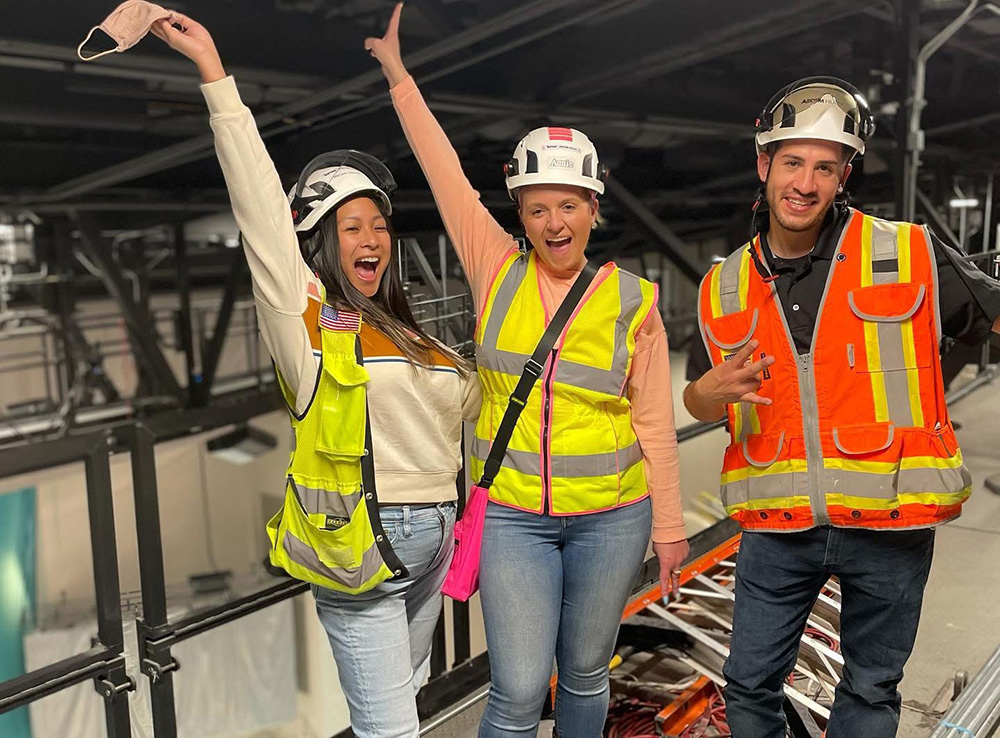
Her journey began in the world of fine arts and fashion design — a background that might seem a world away from a construction site, but one that provided the foundational creativity she uses every day as a Virtual Design and Construction (VDC) Manager at Webcor.
After a college internship in the fashion industry, Annie realized the environment lacked the steady, reliable atmosphere she was looking for. She shifted gears, taking a receptionist role at an interior design firm to test the waters in architecture. That move sparked a series of transitions: from receptionist to marketing coordinator, and eventually to a marketing role at Turner Construction in New York.
"I enjoyed marketing a lot, but the only challenge was the time — I was constantly cranking out proposals and graphics," Annie recalls. Seeking something more operations-based, she accepted an on-the-job training offer for VDC.
The Universal Language of Problem-Solving
Transitioning into VDC was a "tech challenge" of the highest order. Working in Revit and managing trade coordination on-site required Annie to master complex MEP (mechanical, electrical, and plumbing) systems without a traditional engineering background. "When I first started on-site, I really didn't have the engineering background a lot of people do," she says. "It was another level of 'wow.' But over time, I learned what I needed to."
Her strategy was simple and direct: she admitted what she didn't know and sought help from the experts in each trade. "My style was just to admit I didn't have the knowledge and to look for all the help I could get. I had experienced people from each trade helping me learn."
This humility led her to discover that the construction industry has a remarkable capacity to accommodate people with diverse skill sets. "What's very cool about this industry is that there's room for people with a lot of different educational backgrounds. Problem-solving,” she says; “anyone can be good at that."
Finding Culture and Stability at Webcor
Annie moved to Los Angeles seven years ago and joined Webcor four years later, after stints at other major firms. For her, the move to Webcor was driven by a desire for genuine connection. At previous firms where the home office was out of state, there was often a sense of isolation.
"I wanted to work somewhere more California-based. At my previous firm, the main office was in Arizona, and I felt disconnected," Annie explains. "Webcor is absolutely different. People are very friendly; it's a different culture."
That culture has provided a sense of stability that Annie found lacking elsewhere. "Coming to Webcor felt more like having a history with the company — with the leaders and the people I worked with on projects," she notes. Her current work extends into ACC (Autodesk Construction Cloud), where she is helping to build formal training programs. "SMEs get so busy with their day jobs," she says. "I'm working on a program for that. It allows me to meet more people and get involved with more workflows than the typical VDC tasks."
A New Normal for Representation
When Annie started her career in New York, women were a small minority—perhaps six out of a team of 70. Today, she often finds herself in meetings where women outnumber men. On the San Benito Student Housing project at UC Santa Barbara, for instance, the entire dedicated trade coordination team was composed of women. She has observed past industry attempts to "artificially" balance teams — such as assigning women specifically to hospital projects or women’s colleges — but Annie views the organic presence of women in leadership as the ultimate goal.
"At other GCs I worked at, there were no women in roles as senior as (Sr. VP) Allison McCue or (VP) Kamika Kilgore," she says. "It doesn't surprise me now; it seems par for the course.
“Women should be in these roles,” she says. “It should just be normal." For Annie, the focus remains on the quality of the work and the support found in the day-to-day environment. "It's important to be around women who are supportive every day."
Finding a Personal Style in the Field
As a self-described "shy and quiet" communicator, Annie has had to find her own voice in an industry often characterized by outgoing, assertive personalities. "I have to find my style for communicating with men who may not be expecting to see me there or are not used to working with a shy woman," she explains. This internal navigation is as much a part of the job as the software she masters.
Her advice to the next generation? Don't wait for a "roundabout path" if you can find your way to STEM early. "I wouldn't recommend that path if they could decide earlier," she admits. "There was a time I was questioning my decisions, wondering what my career path would look like." However, she has demonstrated that a background in art can be the perfect precursor to a career in digital construction. "When I was studying art, my dad tried to encourage graphic design because it was the 'practical' art, but I didn't like computers back then. Then I switched, and I started loving them."
Whether she is organizing luncheons for a hundred women in the trades or refining virtual models, Annie’s focus is on the human element of the build. "You have to find your own style to fit with the team and get along with people," she says. In the end, the most sophisticated software in the world is only as good as the communication between the people using it.