In honor of Women in Construction Week (WiC Week), we’re spotlighting five outstanding women selected by the Women of Webcor (our employee resource group for women, open to ALL Webcorians) leadership committee who have made exceptional contributions to Webcor while embodying our core values.
She was anxious to take on new challenges at a larger, more established GC and support more complex projects, but she wasn’t sure where. As she researched the companies behind some of her favorite buildings in San Francisco, however, the answer became clear: a California-focused commercial contractor called Webcor.
She decided to ask her former colleague, a retired union carpenter who knew her and her work history well, for his honest opinion: Did she have what it took to succeed at a large GC like Webcor?
“He looked at me kind of sadly and said, ‘No, they’ll eat you alive,’” she recalls. She submitted her application anyway.
Weeks later, she was standing at the Grand Hyatt at SFO project site as one of Webcor’s newest project engineers (PEs). After about a year, she was promoted to senior PE while wrapping up the Grand Hyatt, which went on to win the Design-Build Institute of America’s (DBIA’s) National Award of Excellence in 2020.
Shifting From Design to Construction
Cibele studied architecture at the California College of the Arts (CCA), an art school that emphasizes craft and delivery as much as design. After graduating with her Bachelor of Architecture, she worked for architecture firms as a designer for almost six years.
Around that sixth year, she realized she was beginning to outgrow her career path. She wanted to do more than design—she wanted to bring those designs to life.
She soon landed a job as a bench carpenter operating a computer numerical control (CNC) at a custom woodwork shop, where she stayed for a few years before pivoting to project management at a small GC. There, she realized that as much as she excelled at and enjoyed architecture and design, she clearly loved construction more.
“In architecture, we work inside our minds, which makes the work feel quiet and solitary,” she says. “Construction is more tangible and collaborative, and the energy from everyone working together on the project is livelier. It doesn’t hurt that construction pays better too!
“However, I do think both fields attract people who see their work as a passion—not just a job.”
Of course, that’s not to say she isn’t still working her architectural muscles. Her design background has positioned her as a uniquely effective collaborator who understands and appreciates architects’ vision and goals. “Hopefully, they see me as a partner instead of an adversary!”
Lessons Learned at Webcor
As an assistant project manager, Cibele now approaches every issue knowing the best thing she can do is something—even if it’s not the perfect move. She no longer lets the fear of making a mistake intimidate her into freezing up. When faced with a problem, waiting around for a solution isn’t helping anyone.
She’s also learned the immeasurable value of listening and observing. When people take the time to truly absorb what others are saying instead of talking over one another, she says, a clear path forward often emerges.
These types of hands-on, real-life lessons learned on the job have been the most rewarding part of her Webcor experience. Fortunately, she knows plenty more are ahead at UCSF Health Helen Diller Hospital—a life-changing project that’s become the most gratifying accomplishment of her career.
“I’ll always be proud of my contributions to HDH,” she says. “It’ll be standing tall and taking care of people long after I’m gone.”
Building a Long-Term Career at Webcor
It’s been almost 15 years since Cibele left the architecture world to figure out her next move. Today, she’s grateful to say she’s never been more confident about the direction her career’s headed and hopes to stay with Webcor for many years to come.
Beyond her own career advancement, though, Cibele recognizes that moving up in this industry is a win for all women who are underestimated, dismissed, and questioned for daring to work in construction.
“Being underestimated is a near-universal experience for us,” she says. “But our success is even more gratifying when it proves the doubters wrong!”
Recently, she ran into the retired union carpenter who had once said Webcor would “eat her alive.” “When I saw him, he’d already heard I’d joined Webcor,” she says. “He was so proud of me!”
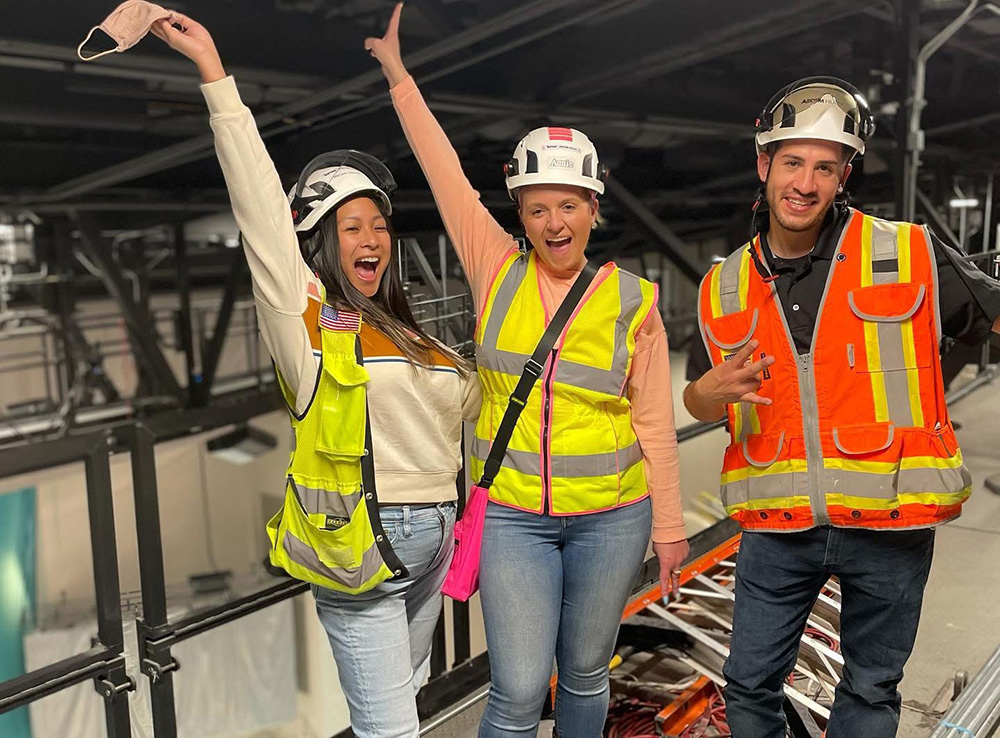
Annie Eismeier didn’t start her career with a hard hat or a Revit model.